
Why the next competitive advantage won't come from larger models—but from a new layer of market intelligence
Every major enterprise is investing in AI.
Some are deploying copilots. Others are building intelligent agents. Many are creating enterprise AI platforms intended to transform customer experience, operations, sales and decision making.
Most of these initiatives begin the same way. They connect AI to enterprise documents, CRM systems, operational data, support history, product information, knowledge bases and business applications. The objective is straightforward: give AI access to everything the organization already knows.
It's a logical architecture, and for many use cases, remarkably effective.
But after spending the past year integrating AI with customer journey intelligence across multiple enterprise environments, we've come to believe something important is missing.
Not another model. Not another agent. Not another application. A new layer of intelligence.
The three layers of enterprise intelligence
Every enterprise AI platform is built on intelligence from multiple sources. Today, two of those layers are well established.
Enterprise memory—everything the organization already knows: documents, policies, customer history, contracts, product information and institutional knowledge. It is static by nature, updated when someone writes something down, not when the world changes.
Operational intelligence—everything happening inside the business today: transactions, customer interactions, support activity, telemetry, workflows and operational performance. It is live, but it is entirely self-referential: it can only report on what the enterprise's own systems were able to see in the first place.
Together these layers allow AI to understand the enterprise extraordinarily well. They explain what has happened. They explain what is happening. Neither one, on its own or combined, can explain what is happening outside the enterprise—and that is where an increasing share of the decisions AI is now being asked to help with actually live.
But eventually every organization begins asking different questions:
- Are customers changing their buying behavior?
- Is this unique to us, or happening across the market?
- What expectations are competitors creating before prospects ever engage with us?
- Which journey patterns are emerging across our industry?
Those questions are fundamentally different. They're not about the enterprise. They're about the environment your customers are navigating.
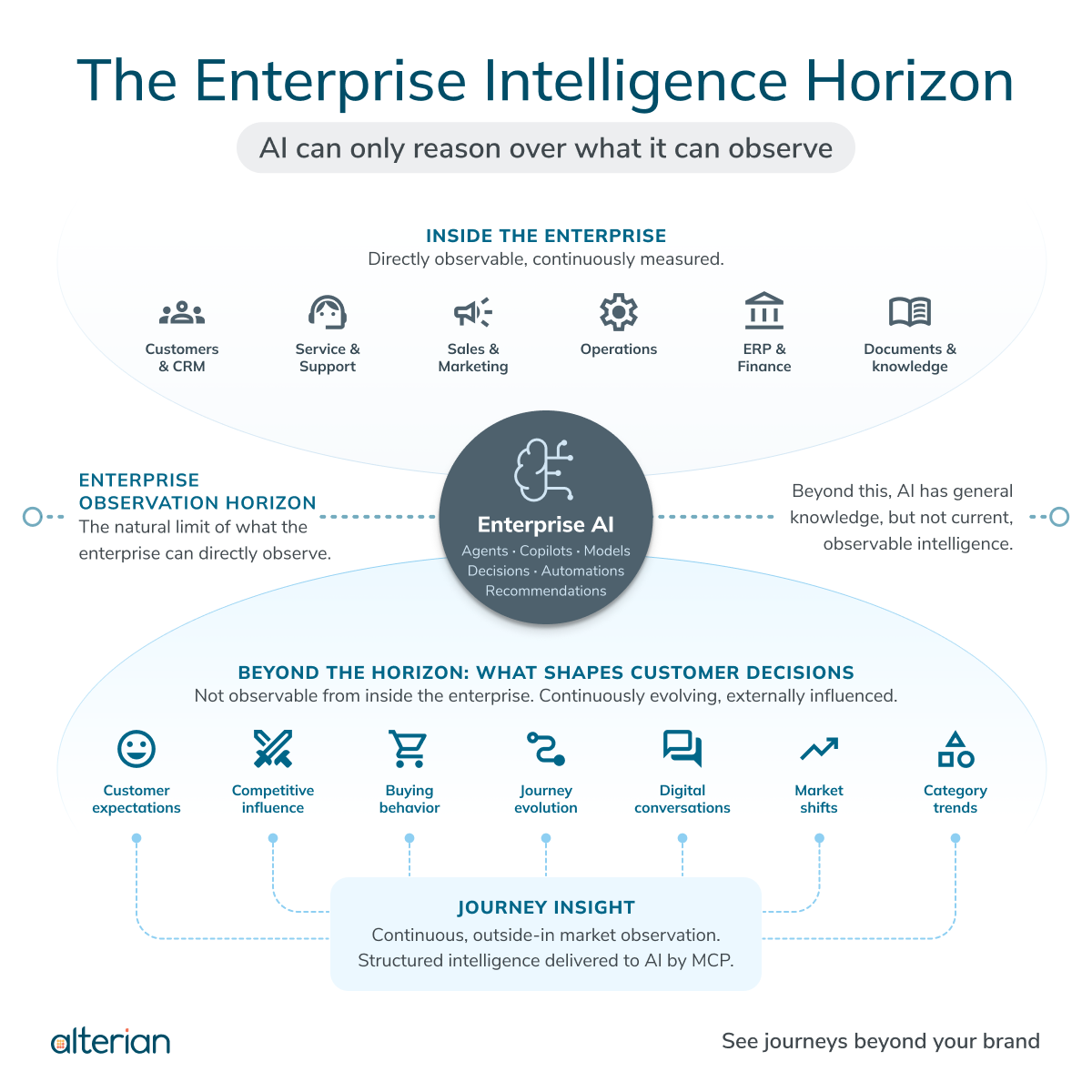
Enterprise AI has excellent visibility inside the enterprise, but naturally reaches the limit of what it can directly observe. Market intelligence extends that observation beyond the enterprise horizon.
Doesn't AI already know the market?
This is usually the first question we hear.
Today's large language models have been trained on enormous amounts of public information. They can discuss industries, competitors, customer behavior and market trends with remarkable fluency. So why isn't that enough?
Because there is an important difference between general intelligence and observed market intelligence.
A foundation model learns statistical relationships from massive collections of historical content, frozen at whatever point its training data ended. It becomes exceptionally good at explaining what is generally true of an industry, a category, a type of buyer. It has no way to know what changed last quarter, what a specific competitor announced last week, or how your specific customers are behaving right now—because none of that is something a model can be trained to know in advance. It has to be observed, continuously, after the fact.
Enterprise decisions require something different. They require intelligence that is current, continuously observed, structured, and grounded in real market behavior—not recalled from a snapshot of the internet that may be a year or more out of date by the time a model ships.
An executive might ask:
- What are buyers comparing before they choose a vendor like us today?
- Which customer expectations have changed over the last six months?
- What journey patterns are emerging in our industry?
An LLM will almost always produce an answer. It may sound thoughtful. It may even sound authoritative. But unless that answer is grounded in observed market intelligence, it remains a probabilistic response, not operational evidence.
As AI becomes responsible for more strategic recommendations, that distinction becomes increasingly important.
Confidence should never be confused with observation.
The missing layer
This has led us to think differently about enterprise AI architecture. Beyond enterprise memory and operational intelligence, we believe there is a third layer: market intelligence.
Not reports. Not dashboards. Not static research. But continuously observed intelligence about the environment shaping customer decisions:
- Customer expectations
- Buying behavior
- Competitive positioning
- Emerging journey patterns
- Category shifts
- Digital influence
Without this layer, AI can accurately explain what's happening inside the enterprise while missing the external forces driving it.
This is the layer Journey Insight is built to provide. Rather than another dashboard to check separately, it observes customer journeys, competitive positioning and category shifts continuously, and structures what it sees into intelligence an AI can actually reason over. Inside Journey Insight, that shows up as Journey Insight AI: an AI analyst a team can ask natural-language questions of directly, grounded in what has actually been observed about the market rather than what a model assumes is generally true.
Market intelligence is becoming infrastructure
Historically, market intelligence was something people consumed. Analyst reports. Competitive briefings. Quarterly research.
Useful information, but separate from day-to-day operations.
Enterprise AI changes that expectation.
Market intelligence increasingly needs to become part of the AI architecture itself: continuously refreshed, machine-readable, available through APIs and emerging standards such as MCP, embedded directly into AI workflows and decision making.
Journey Insight MCP is what that looks like in practice: it makes Journey Insight's observed market intelligence available directly inside the AI tools a team is already using—Claude, ChatGPT—rather than requiring anyone to leave their workflow, open a separate application, and go looking for it.
Not another application. Another layer.
A different question for enterprise leaders
As organizations continue investing in enterprise AI, perhaps the most important architectural question is no longer which model should we deploy? Or even how do we connect more internal data?
Instead, consider asking:
What critical market intelligence is our AI missing today?
Because every enterprise AI system eventually reaches the natural limit of what it can observe from within the business. The next generation of enterprise AI won't be defined solely by more capable models. It will be defined by richer intelligence.
And that intelligence won't come only from inside the enterprise. The organizations that close that gap first won't just have better-informed AI—they'll be making decisions on what the market is actually doing, while everyone else is still working from what their own systems happened to capture.
Expand your AI observation beyond the enterprise horizon
See what your AI is missing.