AI is commoditizing agency execution. New Journey Insight data on the US insurance journey shows why observed market behavior is the next agency advantage.
Alterian · 2026-09-09 · 7 min read
The most prominent organization in the US personal-insurance buying journey isn't Progressive. It isn't State Farm, GEICO, or USAA. It's Costco.
In the first quarter of 2026, Costco appeared in 40.5% of observed US personal-insurance buyer journeys—more than twice the reach of the largest individual carrier. Credit Karma was second. NerdWallet was fourth. Three of the four organizations that show up most often in the journey weren't insurance carriers at all.
For an agency working with an insurance brand, that is more than an interesting data point. It is a warning about how much of the market can sit outside the picture we normally use to make marketing decisions.
Two ways to look
The market your client's analytics can't see
Most marketing analytics begin with the brand: who came to the site, where they came from, which campaign produced the visit, what converted. Competitive-intelligence tools extend that view—they can estimate a rival's traffic, expose referring and destination domains, and surface overlapping audiences. Those are real capabilities.
But there is a different question. Instead of starting with a website and asking where its traffic came from, start with the people making a decision and ask where their whole journey took them. Do that, and Costco appears.
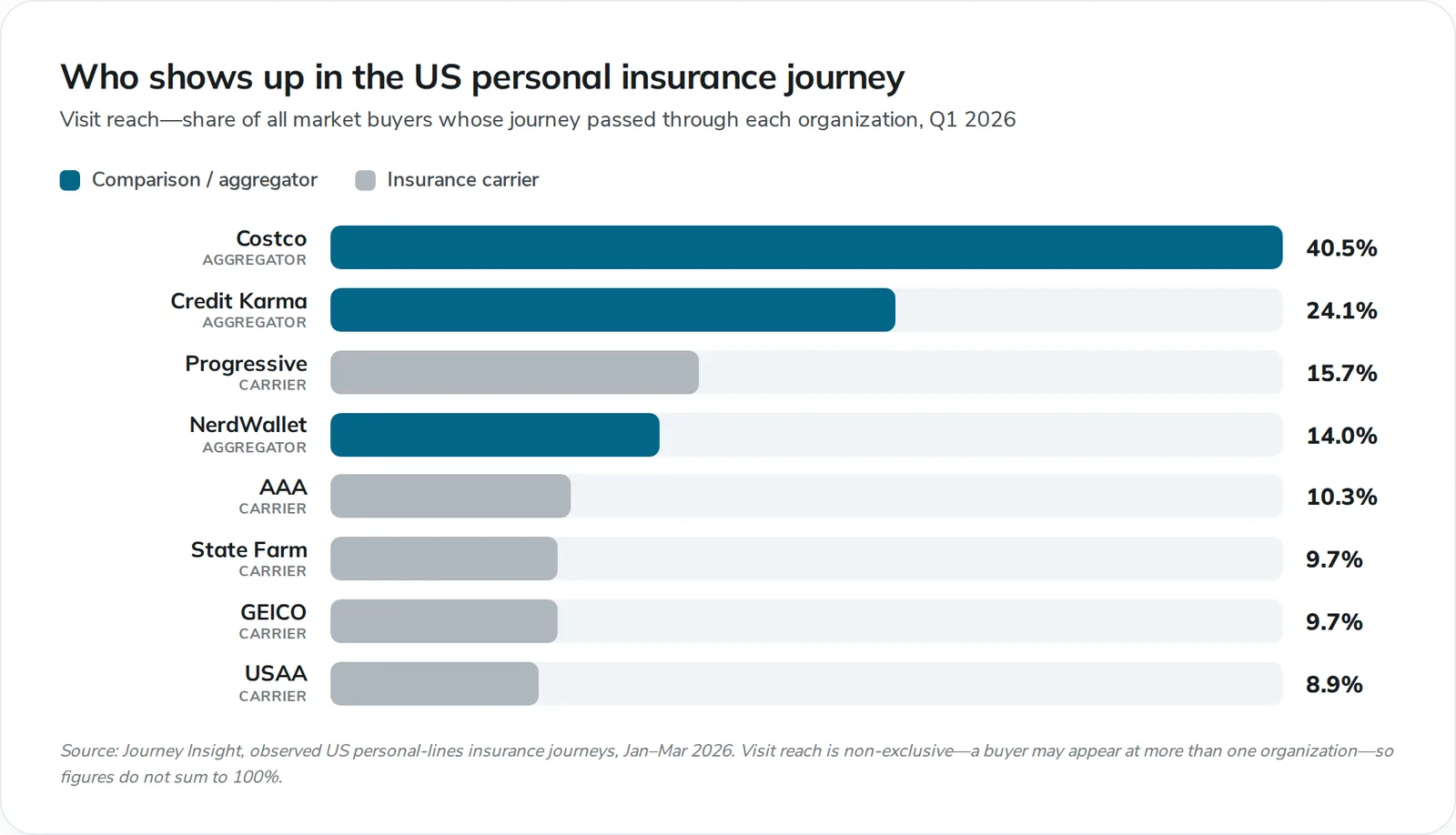
Visit reach in the US Personal-Lines Insurance journey, Q1 2026. Source: Journey Insight.
A domain-centric view can tell you a great deal about Costco, or Progressive, or GEICO on their own. A journey-centric view asks what role all of them play in the same population's path to a decision—and that is a picture no single brand's analytics contains. A warehouse club sits at the center of the category, and it took observing the journey to see it.
Why measurement can't keep up
The most influential brand in the category is invisible to conventional attribution
Here is where it gets sharper. Costco reaches roughly one in four of every carrier's buyers. Yet in the observed journey data, it shows zero direct click-throughs to any carrier. People visit Costco and a carrier in separate sessions, mediated by a return to search—so Costco works as a shared consideration touchstone, not a referral link.
Depth, not just direction
Your tools can see the last click. Not the road to it.
Here is the objection worth meeting head-on: any SEO or traffic tool can already show you the step immediately before a visit. True—and that is exactly the limit. It sees the doorstep. It can't see the street people walked to get there, or where they wandered once the decision was underway.
Look two steps back and a whole channel appears that no rank tracker can. A meaningful share of Progressive's buyers arrive through the insurance-agent ecosystem—routed from an agency, through an agent rating platform, into Progressive—with no search engine anywhere in the path.
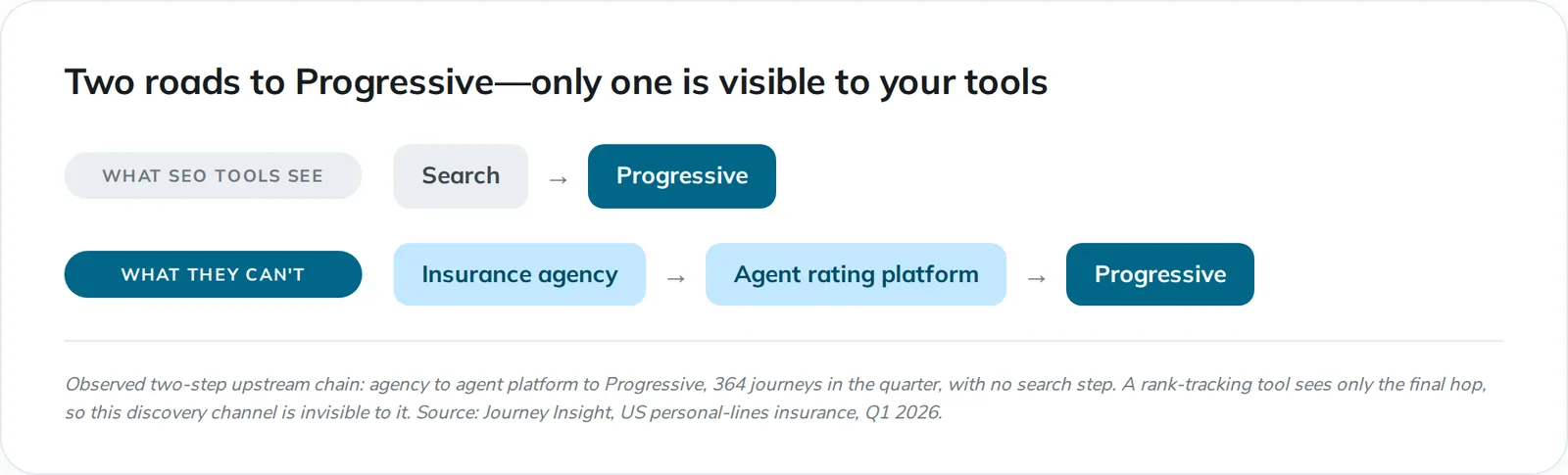
Two upstream roads to Progressive—only one is visible to conventional tools. Source: Journey Insight.
The origin differs by brand, which is the point—each is a different market you can only see by observing it. USAA's buyers arrive through banking and card platforms (Chase, American Express, Wells Fargo) as they manage a financial portfolio; State Farm's deepest non-search path barely exists at all. And once buyers are inside the decision, they leave and come back: YouTube is a mid-session stop for 1.8% to 2.6% of every carrier's buyers. ChatGPT now appears on both sides of the visit—immediately before all four carriers this quarter, as high as 1.4% of USAA's journeys, and again mid-decision after a carrier has been seen. A year ago that behavior was effectively nonexistent; the share is small, the trajectory is not. None of it is a keyword, a rank, or a referrer. It is observed behavior, and it is where the decision is actually being made.
The structural squeeze
Three forces are shrinking what agencies can sell—at once
The insurance market is one worked example of something happening across every category an agency serves. Three shifts are converging, and they compound.
- AI is changing discovery. Agencies can see less of how customers find and evaluate brands. Nearly two-thirds of agencies name AI Overviews as their top concern, and AI answer engines are now entering the journey directly—as the ChatGPT data shows.
- Attribution is losing credibility. Clients ask agencies to connect activity to business results precisely where conventional attribution has the least visibility into the real decision journey—the Costco effect, in every category.
- AI is commoditizing execution. Six in ten senior marketing leaders have cut agency spend because of AI. If the in-house team can create content, analyze campaigns, and build the deck with AI, then doing the work is no longer reason enough to keep an agency.
Put them together and the consequence is plain. When an agency can see less, prove less, and offers work the client believes it can now do itself, the agency becomes easy to cut. That is why budget pressure is now the number-one reason clients leave—42% of churn, ahead of performance. Budget cuts are the symptom. The shrinking field of view is the disease.
The turn
From execution partner to intelligence partner
The defensive move is to protect the retainer. The bigger move is to change what you sell. When execution becomes abundant, the scarce and valuable thing is a coherent behavioral view of the market—and that is not a volume-of-data problem. Agencies already have plenty of data: client analytics, media platforms, CRM, search and traffic tools, social listening, and AI to read all of it. What almost none of them have is observed answers to the questions no dashboard holds—where consideration begins, which competitors enter the journey first, who is switching to whom. Even the competitive-intelligence category is moving this way, toward clickstream journeys rather than traffic estimates alone. The need is real; what it takes is a different field of observation.
Try one of these AI prompts in Journey Insight
- Show me which organizations appear most often in my market's buyer journeys, including non-competitors, and where they sit relative to the carriers.
- Map the journey paths two steps before and after visits to the leading brands in my market to reveal discovery channels my SEO tools can't see.
- Show me the cross-shopping flows between the top brands in my market—who is switching to whom, and which audience is the most insulated.
AI raises the value of that question, it doesn't answer it
This is the distinction worth building a business on: AI makes everyone smarter about the data they already have. It does not give anyone visibility into behavior they never observed. Point an AI at your analytics and it will summarize the last click brilliantly—and still not show you the two steps before it or the detour in the middle. An in-house team armed with AI is working from the client's own footprint. The observed market is the one thing that footprint can't contain.
So the question stops being how to defend the work, and becomes a better one: what could an agency sell that only observed behavior makes possible?
The offer
What an agency could sell
The same observed market becomes a set of things a client will pay for—products that sit above execution, where AI can't easily follow.
- Market opportunity assessment. How buyers actually navigate the category, which organizations shape the journey, and where unseen opportunity is forming.
- Competitive journey intelligence. Not a rival's traffic volume, but how audiences discover, evaluate, and cross-shop between the client and its competitors.
- New-business intelligence. Walk into a pitch able to show a prospect something about its own market it didn't know—not a website audit, not keyword rankings.
- Quarterly market review. What changed in the market this quarter: which competitors gained, which pathways emerged, which platforms began to matter more.
These aren't hypothetical. In the same insurance market, Progressive was the net winner of cross-shopping—GEICO users moved to Progressive at four times the rate they moved back (3.6% of GEICO's journeys against 0.9%), two-thirds of GEICO's audience was cross-shopping, and USAA's was the most insulated. That is competitive strategy, and strategy is far harder to commoditize than execution.
Every figure here came from Journey Insight—observed, anonymized behavioral journeys across the US personal-insurance category, pulled in minutes through the Journey Insight MCP inside the tools you already use.
Journey Insight turns observed market behavior into competitive, market, and journey intelligence you can use for your own strategy—and package into new offerings for your clients.
Because when execution becomes abundant, the scarce advantage isn't doing more. It's seeing what everyone else missed.
Get free insights on your customer journeys
Sign up for our robust Free Plan in just a few minutes.
About the data | US Personal-Lines Insurance, Q1 2026
Every figure here came from Journey Insight—observed, anonymized behavioral journeys across the US personal-insurance category, January–March 2026, pulled through the Journey Insight MCP inside the tools you already use. Figures reflect visit reach, engagement, and observed multi-step journey flow across permissioned behavioral data—not sales, revenue, or market share.
Industry statistics on agency concerns, churn, and AI-driven spend reflect 2025–2026 marketing agency research. Analysis performed using Alterian Journey Insight. See the US Personal-Lines Insurance market in Journey Insight.