
Voice of customer insights are extremely valuable, helping businesses to capture feedback and learn more about opinions, motivations, and brand and product experiences. But in this increasingly customer-centric world, it is no longer enough to measure sentiment after the experience has happened.
Comprehensive real-time data and in-the-moment action is essential if you are to keep up with the evolving needs of today's customers and improve their experience as it's happening. In this article we explain how customer journey analytics and customer journey orchestration can be used to complement VoC insights and enhance CX performance.
It has become increasingly difficult for businesses to differentiate themselves based on product alone. Now, the businesses that deliver exceptional customer experiences are the ones standing out and benefiting from a happy, loyal customer base. To achieve true customer-centricity, teams must look to new technology that supplements their existing setup while enabling them to take customer initiatives to the next level.
The world's CX leaders are already doing it, integrating customer journey analytics and customer journey orchestration with existing VoC insights to deliver best-in-class experiences.
Imagine a world where you not only learn about your customer via a VoC platform but also by their behavior at that very moment. What they were doing or trying to do; what they were seeking out. Then, imagine being able to influence and improve that experience for them so that their journey was seamless. That is the ultimate CX goal.
It starts with customer journey analytics
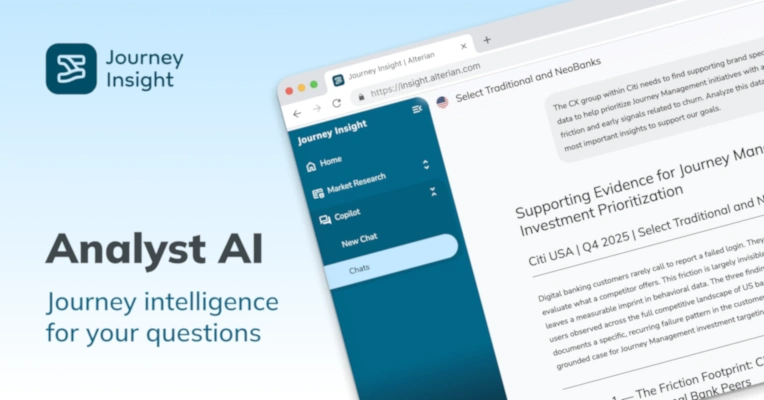
Customer journey analytics provides businesses with a more comprehensive look at what customers are actually doing, or trying to do, as they interact with your brand. This demonstrates critical information and behavior and alerts teams to major friction points they would otherwise have missed if they were relying on VoC alone.
Here's an example. Mike wants to pay his electricity bill online. He heads to the website, but the login process is complex and confusing. After 15 minutes of trying, he gives up, calls the call center, waits another 10 minutes to be connected to a representative, and eventually pays over the phone. He is so frustrated he couldn't simply pay online that he submits negative feedback.
When the electricity provider sees Mike's negative feedback, they assume he—and other customers like him—aren't happy with the call center experience. But a key piece of the story is missing. Without that critical insight into the source of the frustration, in this case a complex login page, the business is set to invest time and money into solving the wrong problem.
Now imagine that same scenario but with the addition of customer journey analytics. The actions of the business would likely be quite different. They would have seen that Mike visited the website and tried to log in without success before switching to the call center to complete the payment.
Customer journey analytics enables you to understand the actual journey of an individual. More importantly, it allows you to identify other customers who are like Mike and helps you understand their journeys and the impact they're having on the business, whether that be CSAT, call center costs, or customer churn rate. Combining this information with VoC results in an accurate and complete customer picture that teams can use to confidently make decisions and drive better results for the customer and the business.
Using both to act and optimize journeys
These insights can then be leveraged to improve customer journeys through customer journey orchestration, achievable through platforms such as Alterian's Real-Time CX Platform. CX teams can design journeys in the platform; once they do, journey orchestration gets to work and begins to automatically optimize customer journeys for every individual as the journeys are happening.
From the moment the customer engages with the brand, customer journey orchestration recognizes and leverages all information it has about the customer and uses the power of AI to predict what journey they'll take and the goal they want to achieve. It then orchestrates the optimal journey to ensure they can achieve that goal with ease.
Because this is orchestrated in real time, the journey is individualized to their needs in that very moment. This prevents frustrating friction points and results in positive outcomes for both the customer and the business.
CX technology is evolving at a rapid pace, and customer-centricity is driving the evolution. To be truly customer-led, businesses must look to complementary solutions that help them listen to their customers, understand their needs, and respond to them when it matters. Integrating customer journey analytics and customer journey orchestration with VoC makes that possible and empowers teams to:
- Collect and analyze customer feedback across all channels
- Monitor customer interactions as they're happening
- Analyze customers' real-time and historical journeys and make decisions with total confidence
- Better understand customer behavior
- Provide individualized experiences to every customer, and ensure journeys adapt to customer behavior in real time
Ready to learn more?
See how customer journey analytics and orchestration can complement your VoC insights.